
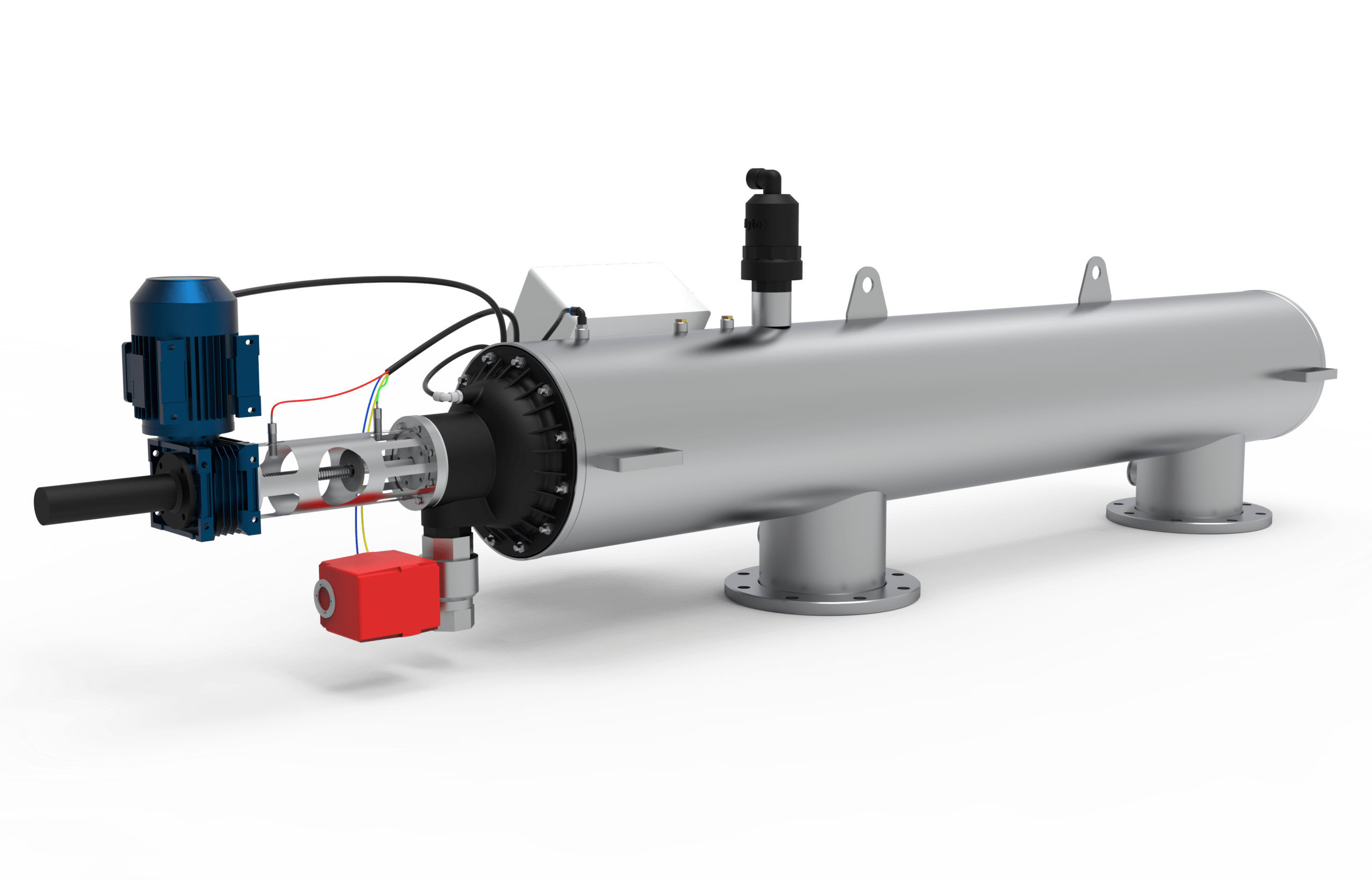
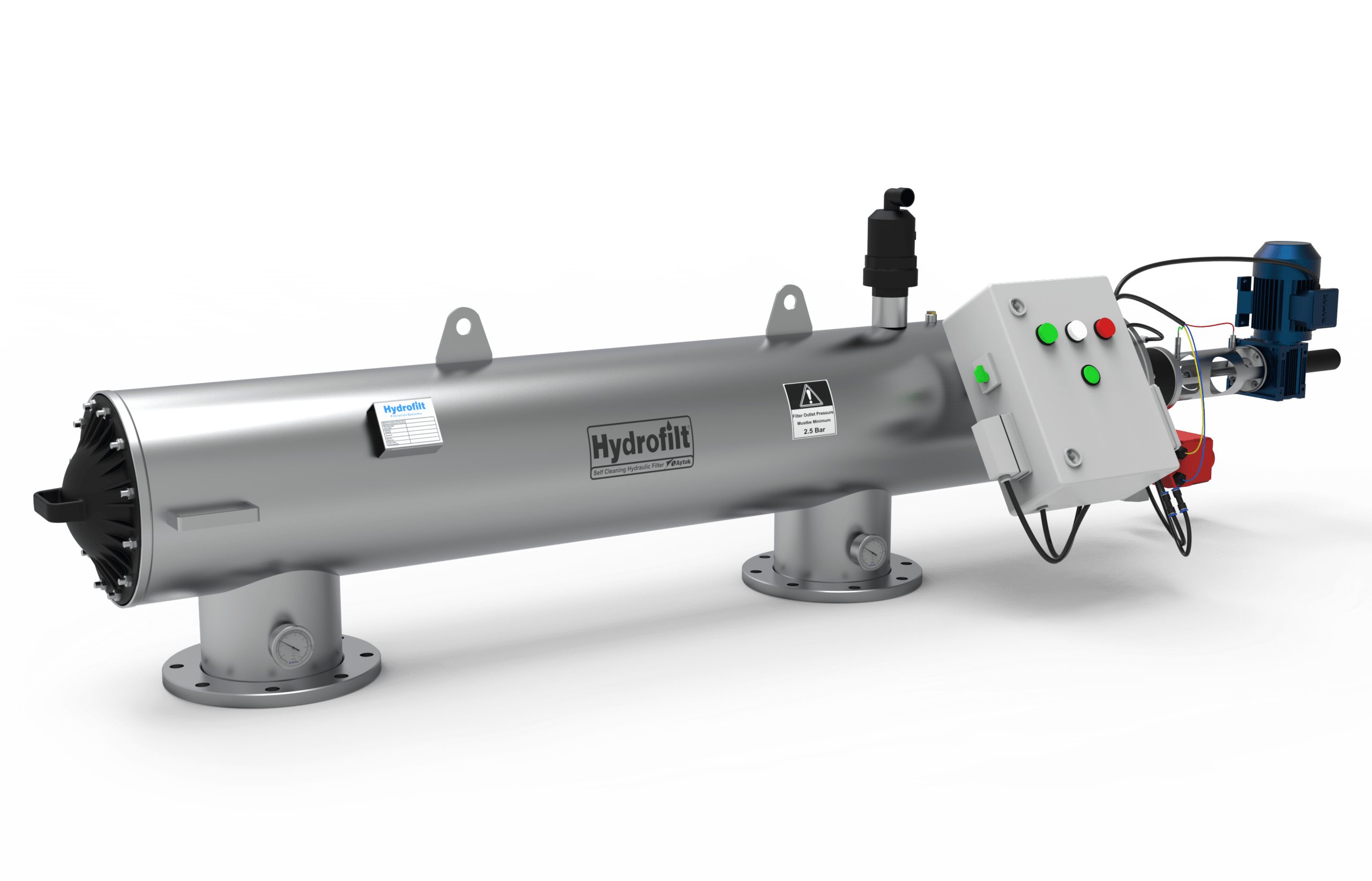
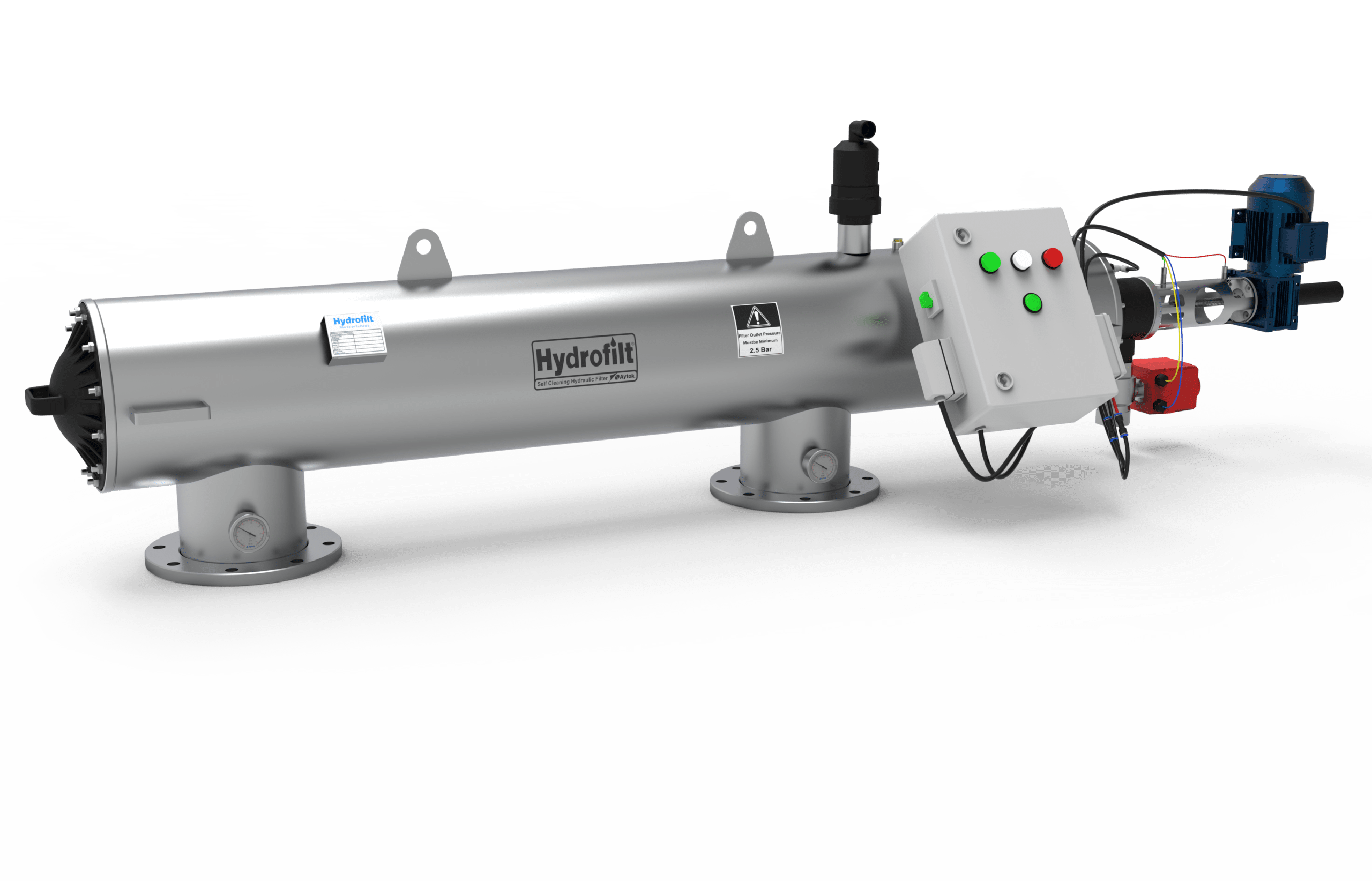
RF/CRF horizontal self-cleaning filters with gear motor are filters in which the collector pipe is moved by the electric gear motor and the dirty water is discharged through the motorised valve.
These filters clean themselves automatically and can run on 220 V and 380 V alternating current.
The ΔP sensor (differential pressure) is used by the electronic control unit to detect the filter's clogging level and to start the self-cleaning.
The opening of the motorised valve, controlled by the control unit, and the forward and backward movement of the collector pipe driven by the electric gear motor, combined with the rotation, remove and flush the particles from the inner surface of the screen.
When the gear motor completes its cycle, the motorised valve closes and the process ends.
While the backwash mechanism is running, water filtration is not interrupted.
The dirty water from this process is discharged automatically during self-cleaning.


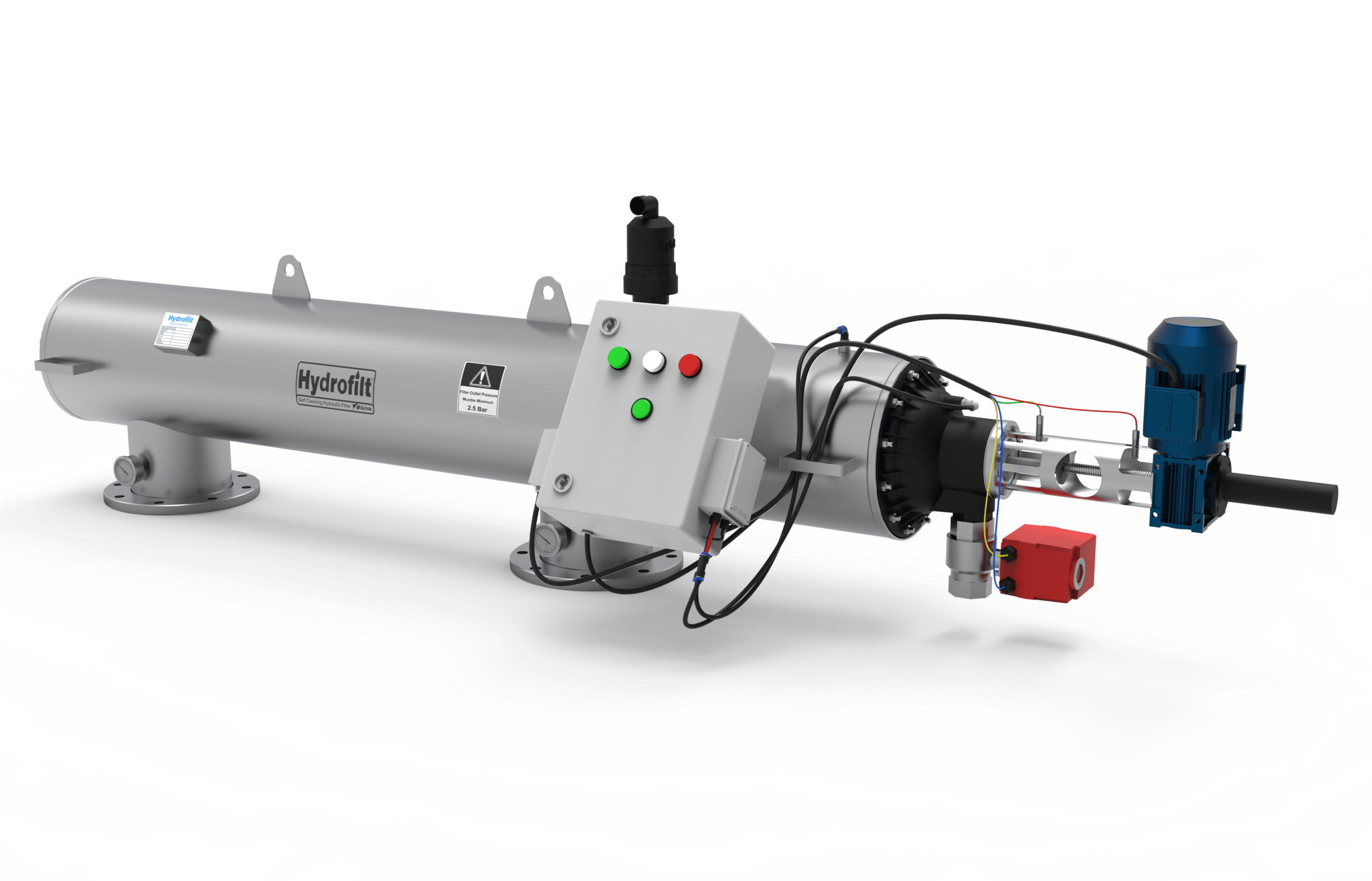


Housing material: S235JR / SS304L / SS316L;
Screen material: SS 304L, PA6GFR30;
Maximum working pressure: 10 bar (145 psi), up to 16 bar on request;
Minimum working pressure: 1 bar (14.5 psi);
Maximum working temperature: 60 °C (140 °F);
Backwash criteria: time and/or differential pressure;
Backwash control unit: electronic control (AC);
Filtration degree: 20–2000 micron (µ);
Painting method: electrostatic powder coating;
Paint material: epoxy polyester.


Operating principle:
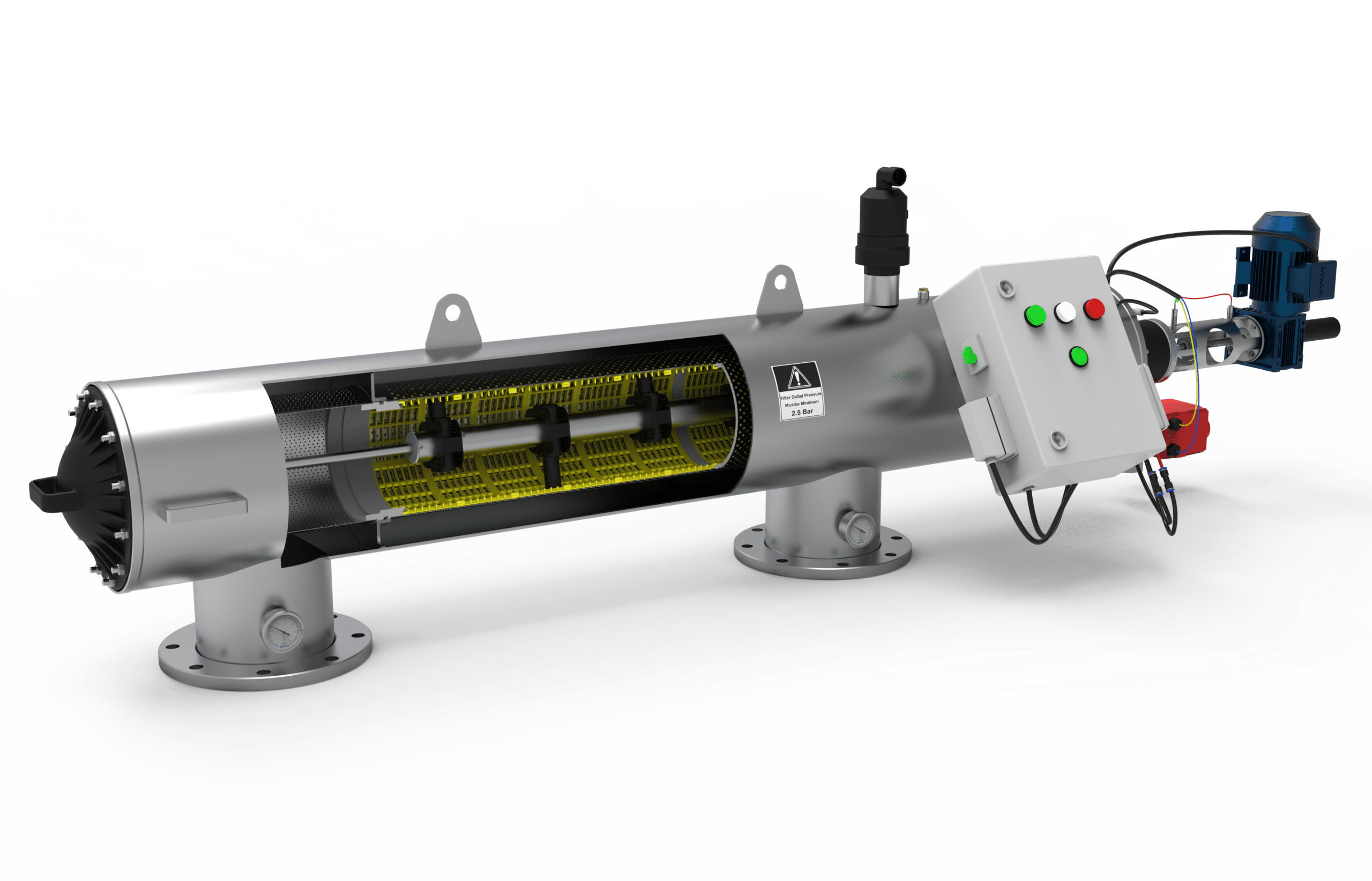
Water entering the filter passes through the coarse screen and then reaches the fine screen. It continues to flow through the fine screen from inside to outside, so the filtered sediment builds up on the inside of the fine screen, causing a pressure drop between inlet and outlet.
This differential pressure is detected by the ΔP sensor and sent to the control unit to start the self-cleaning process. The control unit opens the motorised valve. While the motorised valve discharges the dirty water, the control unit starts the motor.
The rotation of the gear motor gives the suction nozzles on the collector assembly a helical motion. The motion is transmitted through a square-thread shaft.
The gear motor's movement is controlled by optical sensors, so the entire screen surface is scanned and the dirt layer is removed.
The difference between the inlet pressure and the pressure after the flush valve (atmospheric pressure) creates strong suction (vacuum) at the cleaning nozzles, which removes the sediment from the inside of the screen. The sucked-in particles pass through the collector assembly and are discharged through the drain line.
The collector body returns to its starting position, continuing to clean on the way back. The flush valve closes and the cleaning process ends.
Filtration is not interrupted during backwash.
| Product code | RF/CRF104 | RF/CRF104S | RF/CRF105 | RF/CRF105S | RF/CRF106 | RF/CRF126S | RF/CRF128 | RF/CRF1210 | |
|---|---|---|---|---|---|---|---|---|---|
| INLET/ OUTLET | inch | 4 | 4 | 5 | 5 | 6 | 6 | 8 | 10 |
| DN | 100 | 100 | 125 | 125 | 150 | 150 | 200 | 250 | |
| A (mm) | 500 | 600 | 600 | 900 | 900 | 1100 | 1100 | 1100 | |
| B (mm) | 287 | 287 | 287 | 287 | 287 | 312 | 312 | 312 | |
| L1 (mm) | 920 | 1120 | 1120 | 1430 | 1430 | 1822 | 1822 | 1822 | |
| L (mm) | 1770 | 1970 | 1970 | 2285 | 2285 | 2825 | 2825 | 2825 | |
| D (inch) | 10 | 10 | 10 | 10 | 10 | 12 | 12 | 12 | |
| F (inch) | 2 | 2 | 2 | 2 | 2 | 2 | 2 | 2 | |
| Drain flow (m³/h) | 11,9 | 14,8 | 14,8 | 18 | 18 | 23,8 | 23,8 | 23,8 | |
| Flow (m³/h) | 120 | 140 | 150 | 160 | 180 | 220 | 320 | 380 | |
| Filtration area (cm²) | 2634 | 3951 | 3951 | 5268 | 5268 | 7902 | 7902 | 7902 | |
| Nozzles (pcs) | 2 | 3 | 3 | 4 | 4 | 6 | 6 | 6 | |
| Screens (pcs) | 4 | 6 | 6 | 8 | 8 | 12 | 12 | 12 | |
| Weight (kg) | 90 | 100 | 100 | 108 | 110 | 150 | 152 | 165 | |


